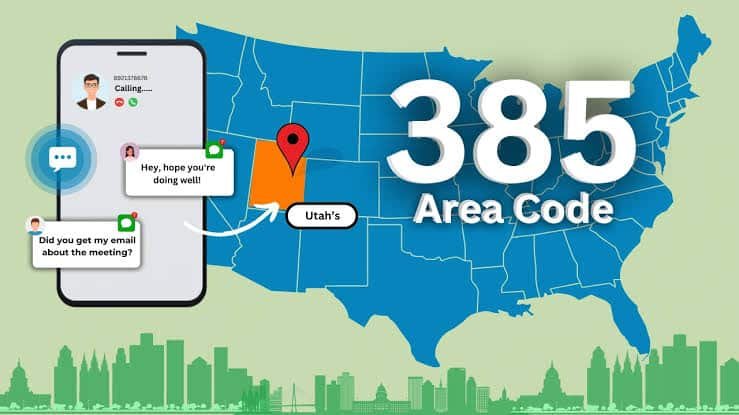
Utah regulators started planning a third area code for the Salt Lake Valley back in 2022, years before 385 itself came anywhere close to running dry. That kind of forward planning reflects just how consistently this corridor has outpaced projections, and it’s exactly the growth story behind 385, the overlay covering Salt Lake City and the surrounding Wasatch Front alongside the original 801.
The Wasatch Front, At a Glance
| Category | Details |
| State | Utah, USA |
| Coverage Area | Salt Lake City, Provo, Ogden, Lehi |
| Went Into Service | March 29, 2009 |
| Time Zone | Mountain Time (MST: UTC-7 / MDT: UTC-6) |
| Overlays With | 801 |
| Future Overlay Planned | 986 |
An Overlay Chosen Specifically to Avoid Disruption
By the mid-2000s, 801’s numbering pool, which had served the entirety of Utah since 1947 before narrowing to the Wasatch Front, was genuinely running low, driven by explosive population growth, mobile phone adoption, and the proliferation of fax lines and pagers through the late 1990s. Rather than splitting the region into separate geographic zones, which would have forced potentially millions of residents and businesses to change established numbers, Utah’s Public Service Commission approved 385 as an overlay in 2008, and it entered service on March 29, 2009.
Silicon Slopes Sits Squarely Inside This Territory
Lehi anchors one of the more economically significant corners of this overlay territory, sitting at the heart of “Silicon Slopes,” Utah’s fast-growing technology corridor that’s drawn software companies and startups away from more expensive coastal markets. That tech-sector growth has been a genuine driver of the sustained numbering demand that’s kept both 801 and 385 filling up faster than regulators initially projected.
Where This Code Actually Reaches
385 overlays identical territory to 801 across eight counties along the Wasatch Front:
- Salt Lake City, West Valley City, and Murray
- Provo and Orem in Utah County
- Ogden in Weber County
- American Fork, Bountiful, and Lehi
American Fork and Bountiful represent the kind of fast-growing suburban communities that have absorbed much of the Salt Lake Valley’s population overflow, feeding directly into the numbering pressure that necessitated this overlay in the first place.
Identical Geography, Zero Practical Difference
Because 385 shares the exact same footprint as 801 rather than dividing it, two neighbouring businesses in downtown Salt Lake City could easily carry different codes today, purely depending on when each one registered its line. That overlap means ten-digit dialing is mandatory for every local call throughout the territory, even between two numbers sharing the same building.
A Numbering Pool That’s Already More Than Half Claimed
Recent tracking shows roughly 62 percent of 385’s available central-office prefixes already assigned across its 20 rate centres, a pace that reflects the Wasatch Front’s continued status as one of the fastest-growing urban corridors anywhere in the western United States. That utilisation rate is precisely why regulators began discussing a third overlay years before either existing code faced genuine exhaustion.
Why 801 Still Carries Slightly More Local Weight
Because 801 has represented this region continuously since Utah’s original 1947 numbering assignment, it retains a modest edge in local recognition compared to 385, even though both codes function completely identically for calls, texts, and business registration. That perception gap mirrors the pattern seen in many American cities where an original code outlasts its newer overlay siblings in local sentiment, even as practical distinctions disappear entirely.
Frequently Asked Questions
Q1. Is it true that Utah already planned a third area code before 385 or 801 ran out of numbers?
Yes, this is documented. Utah’s Public Service Commission proposed 986 as a future overlay back in 2022, well ahead of either existing code reaching genuine exhaustion, reflecting how consistently this region’s growth has outpaced earlier projections.
Q2. Does a 385 number tell you anything about which specific Wasatch Front city the caller is in?
No. Since 385 overlays identical territory to 801 across the entire region, from Salt Lake City to Provo to Ogden, the code alone doesn’t indicate which specific community within that footprint the caller is actually in.
Q3. Is a 385 number less credible than an 801 number for a Salt Lake City business?
Not functionally. Both codes work identically for every practical purpose, though 801 carries a modest historical edge simply from being Utah’s original 1947 code, a perception gap that matters mainly to longtime residents.
Q4. Can a business outside Utah get a 385 number to establish a Salt Lake City or Silicon Slopes presence?
Yes, virtual number providers commonly issue 385 or 801 numbers to businesses anywhere, letting them establish a Wasatch Front presence for technology, healthcare, or general business outreach without needing a physical Utah office.