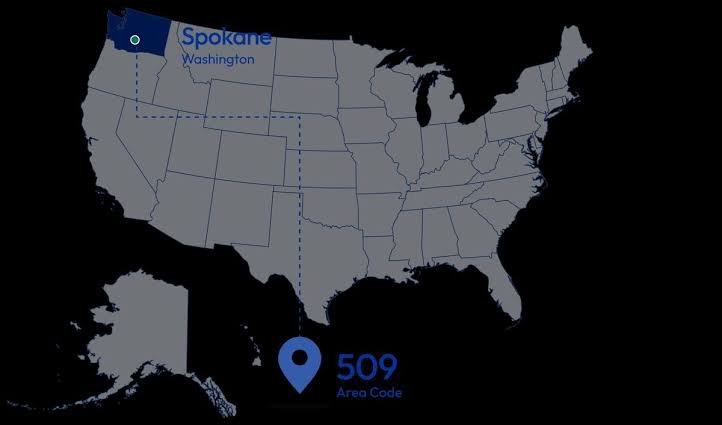
The Yakima Valley produces roughly 75 percent of all hops grown in the United States, a genuinely staggering concentration for a single agricultural region. That brewing-industry powerhouse sits inside the 509 area code, the numbering territory covering the entirety of eastern and central Washington.
Eastern Washington, At a Glance
| Category | Details |
| State | Washington, USA |
| Coverage Area | Spokane, Yakima, Tri-Cities, Wenatchee |
| Went Into Service | January 1, 1957 |
| Time Zone | Pacific Time (PST: UTC-8 / PDT: UTC-7) |
| Overlay Status | None — sole code for its territory |
| Split From | 206 |
A Code That’s Never Needed a Second Prefix
509 launched on January 1, 1957, when eastern Washington split away from 206, the state’s original 1947 code that had covered Washington in its entirety. What makes 509 genuinely unusual is what’s happened since: nearly seven decades later, it remains one of the geographically largest single-code regions left in the country, having never been split again or received an overlay.
Where America’s Beer Industry Draws Its Hops
Beyond Yakima’s agricultural dominance in hops, this same valley supports substantial apple and wheat production, giving eastern Washington genuine claim to being one of America’s most concentrated farming regions for crops feeding directly into national food and beverage supply chains. That agricultural depth sits alongside the Tri-Cities region, Kennewick, Pasco, and Richland, which anchors a genuinely different industry entirely.
A Site Tied to America’s Nuclear History
Richland hosts the Hanford Site, a facility with deep roots in American nuclear energy production dating back to the Manhattan Project era. That legacy has since evolved into ongoing energy research and environmental remediation work, giving the Tri-Cities region an economic identity built around advanced science and engineering rather than the farming that dominates much of the rest of eastern Washington.
Why This Region Never Filled Up Like Seattle Did
Eastern Washington’s population density has remained considerably lower than the Seattle-anchored western third of the state, and that gap explains why 509 has sustained itself without any numbering relief for nearly seventy years. Spanning roughly twenty counties east of the Cascade Mountains, this territory covers about two-thirds of Washington’s total land area while housing a much smaller share of its overall population.
Where This Code Actually Reaches
509 spans everything east of the Cascade crest, from the Canadian border down to the Columbia River Gorge:
- Spokane and Spokane Valley, the region’s largest urban centre
- Yakima, anchoring the state’s hop and apple production
- The Tri-Cities of Kennewick, Pasco, and Richland
- Wenatchee, Walla Walla, and Pullman
Pullman anchors this territory’s academic identity, home to Washington State University and giving eastern Washington a genuine higher education presence distinct from its farming and energy-driven economy elsewhere.
A Flower Festival Marking Spokane’s Own Identity
Spokane hosts the Lilac Festival each May, a genuine community celebration marking local blooms and civic pride that’s become a recurring fixture of the city’s calendar. That kind of seasonal tradition reflects Spokane’s broader identity as a genuine cultural and recreational hub within the Inland Northwest, distinct from the smaller agricultural towns spread throughout the rest of this vast territory.
Frequently Asked Questions
Q1. Is it really true that Yakima Valley produces most of America’s hops?
Yes, this is documented agricultural data. The Yakima Valley accounts for roughly 75 percent of total US hop production, making it a genuinely dominant force in supplying the American brewing industry.
Q2. Why has 509 never needed an overlay despite covering such a massive territory?
Eastern Washington’s population density has remained considerably lower than Seattle’s western metro, meaning demand for phone numbers has stayed within the original 1957 allocation’s capacity even after nearly seven decades of continuous use.
Q3. Does a 509 number mean the caller is likely connected to agriculture or nuclear energy?
It depends entirely on which part of this vast territory they’re in. Yakima leans heavily agricultural, while Richland’s Hanford Site anchors a nuclear energy and research identity, so the code alone doesn’t indicate which industry the caller belongs to.
Q4. Can a business outside Washington get a 509 number to establish an eastern Washington presence?
Yes, virtual number providers commonly issue 509 numbers to businesses anywhere, letting them establish an eastern Washington presence for agriculture, energy, or general business outreach without needing a physical Washington office.