Until 1992, dialling a number in San Antonio and dialling one in Austin meant reaching for the exact same three digits. These two Texas cities, each with entirely distinct personalities today, once shared a single area code for nearly half a century before finally splitting apart. If a number starting with 512 has reached you, it belongs firmly to Austin’s side of that split, a city that’s since built one of the most recognisable tech and music identities in America.
Where 512 Sits Today
| Category | Details |
| State | Texas, USA |
| Coverage Area | Austin, Round Rock, San Marcos, Georgetown |
| Went Into Service | October 1947 |
| Time Zone | Central Time (CST: UTC-6 / CDT: UTC-5) |
| Overlay Code | 737 |
| Split From San Antonio | 1992 (creating 210) |
The Long Marriage That Ended in 1992
When 512 launched in 1947, it wasn’t just Austin’s code, it stretched across most of south-central Texas, covering San Antonio and Corpus Christi as well. That arrangement held for nearly 45 years, an unusually long run for a single area code covering such a large and growing region. By 1992, San Antonio’s population had grown enough to justify its own dedicated identity, and 210 split away to take over the western portion of the territory. Since then, 512 country effectively ends south of San Marcos, with the New Braunfels stretch along I-35 now falling under a different code entirely.
What’s Left Under This Code Today
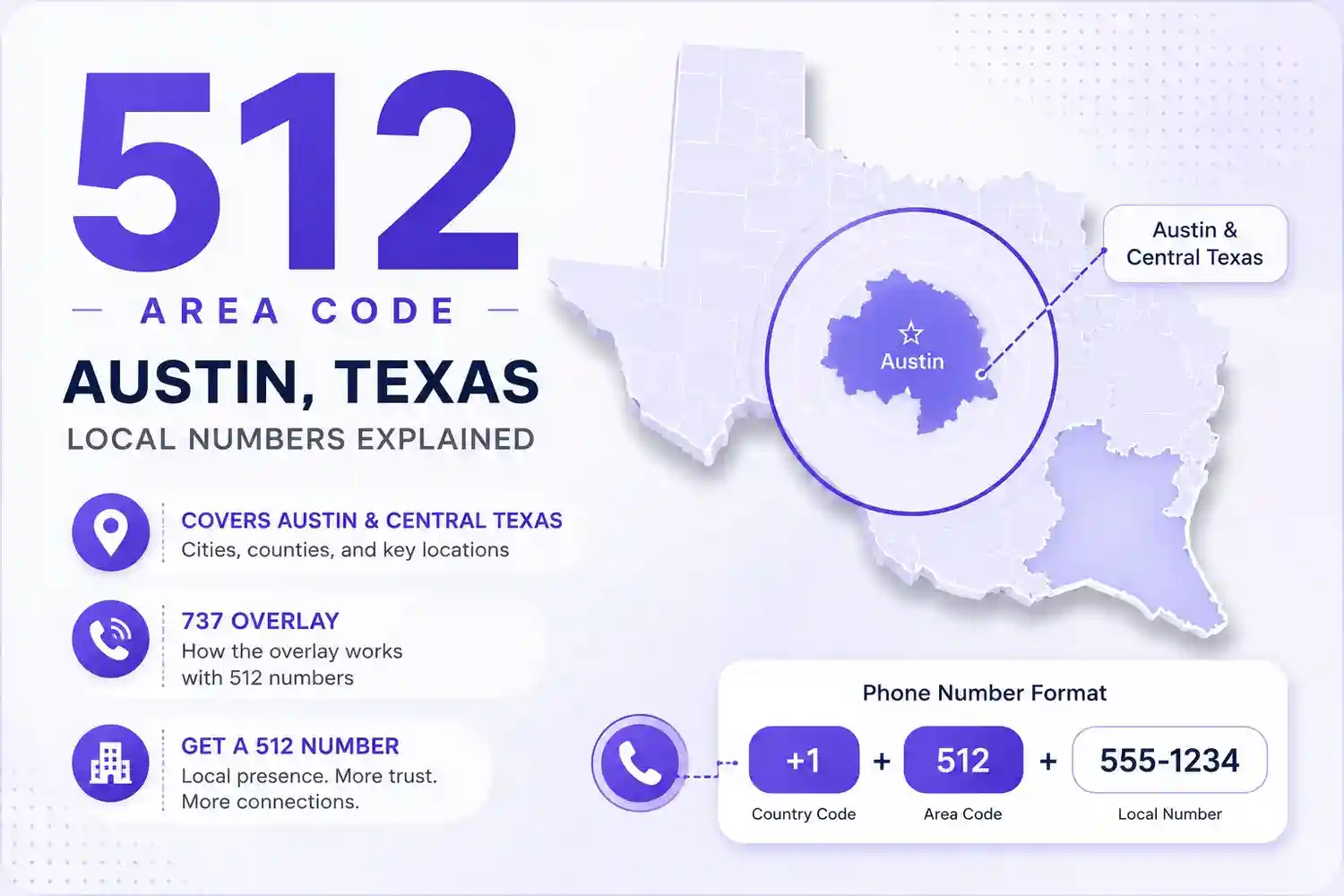
512 concentrates specifically on the Austin metropolitan area and its surrounding Hill Country communities:
- Austin, including downtown, Sixth Street, and Lady Bird Lake
- Round Rock and Cedar Park to the north
- San Marcos, home to Texas State University
- Georgetown, Pflugerville, and Leander
This footprint spans multiple counties, including Travis, Williamson, Hays, Bastrop, and Caldwell, reflecting how far Austin’s suburban growth has stretched beyond the city’s original boundaries.
A City That Built Its Identity Around Contradiction
Austin has spent decades cultivating an identity that deliberately doesn’t fit the rest of Texas: a famously liberal, artistic city sitting inside a conservative state, home to a massive live music scene alongside a booming tech industry that’s drawn major corporate relocations in recent years. That combination, creative culture layered directly onto serious business infrastructure, gives 512 a genuinely distinct economic character compared to codes tied purely to finance, oil, or agriculture elsewhere in Texas.
Why 737 Joined in 2013
Austin’s rapid growth through the 2000s and 2010s eventually pushed 512’s own numbering pool toward exhaustion, driven by both population influx and the explosion of mobile phone adoption. Rather than splitting the metro area again, regulators introduced 737 as an all-services overlay on July 1, 2013, with mandatory ten-digit dialing taking effect just weeks earlier to prepare for the change. No existing 512 number changed as a result, new registrations simply began drawing from the newer code instead.
Two Codes, One Identical Territory
Because 737 covers exactly the same ground as 512 rather than dividing it, a business in downtown Austin and one in a nearby Round Rock office park could easily carry different area codes today, depending purely on when each one registered its line. This is standard overlay behaviour, but it’s worth knowing if you’re trying to guess anything about a caller’s specific neighbourhood from the prefix alone, you genuinely can’t.
Frequently Asked Questions
Q1. Does 512 still cover any part of San Antonio today?
No. San Antonio left this code entirely in 1992 when 210 was created specifically to take over that territory. Since then, 512 has been exclusively tied to Austin and its surrounding Central Texas communities.
Q2. Is a 512 number considered more prestigious than one from the 737 overlay?
There’s a mild historical edge to 512 simply because it’s the original code dating back to 1947, but both function identically for calls, texts, and business registration, so the practical difference is negligible.
Q3. How does someone outside the US dial a 512 number correctly?
Add your country’s international access code, then the US country code, followed by the full 512 number, giving a sequence like 00-1-512-XXX-XXXX. Most smartphones handle this automatically if you use the “+” symbol when saving the contact.
Q4. Does a 512 number mean the business is specifically tied to Austin’s tech industry?
Not necessarily. While Austin’s tech sector has grown substantially and draws plenty of attention, this code also covers university towns like San Marcos, agricultural communities further out, and countless businesses with no tech connection whatsoever.