When Oakland and Berkeley finally got their own area code in 1991, a local resident wrote to the newspaper practically bursting with pride, arguing that just as 408 announced San Jose’s arrival and 707 spoke for the North Bay, the East Bay finally had digits of its own to prove it belonged in the story of the Bay Area too. That sentiment never really faded. Three decades later, “the 510” shows up in rap lyrics, on hoodies, and in shop names across Oakland, a rare case of a phone prefix becoming genuine shorthand for an entire region’s identity.
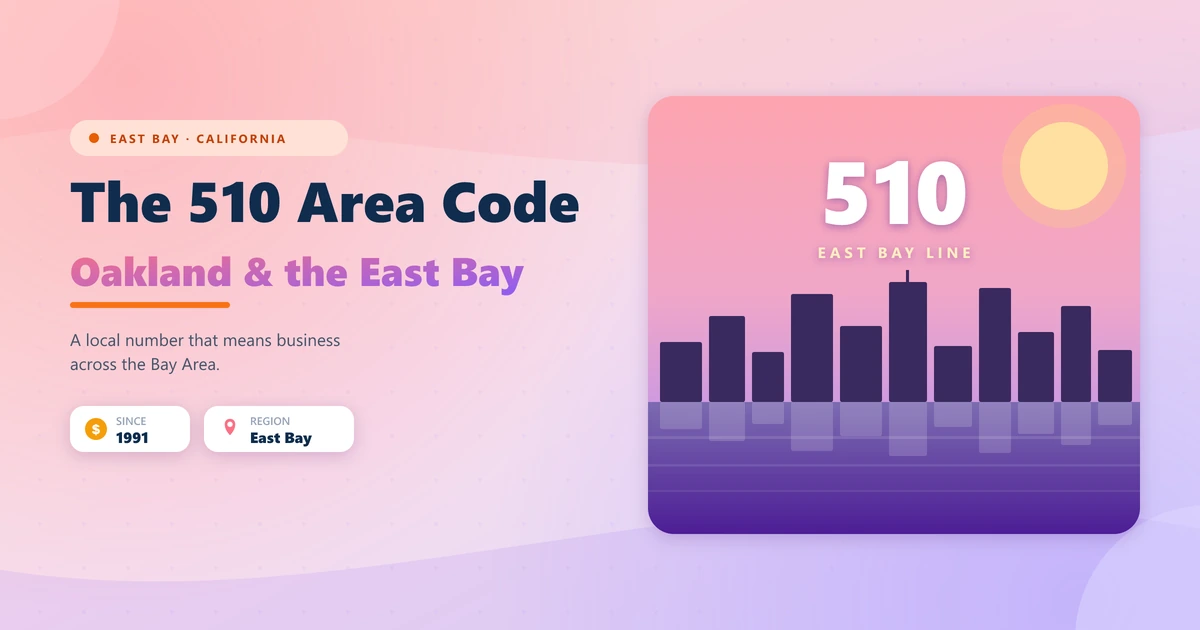
Snapshot: 510 in California’s East Bay
| Category | Details |
| State | California, USA |
| Coverage Area | Oakland, Berkeley, Fremont, Hayward, Alameda |
| Went Into Service | 1991 |
| Time Zone | Pacific Time (PST: UTC-8 / PDT: UTC-7) |
| Overlay Code | 341 |
| Split From | 415 |
Splitting Away From San Francisco’s Shadow
Before 1991, everything east of the bay ran on 415, the same code representing San Francisco itself. That arrangement had quietly bothered plenty of East Bay residents for years, who felt their side of the water deserved a distinct identity rather than being lumped in under a code so strongly associated with the city across the bridge. When population growth finally forced a split, it became the Bay Area’s first new area code since 1959, and East Bay locals treated the moment as more than administrative housekeeping. It was recognition.
A Code That Genuinely Ran Out of Numbers
Here’s what makes 510’s story unusual compared to most area codes: it didn’t just get crowded, it actually ran completely dry. By 2018, California regulators confirmed there simply weren’t any 510 combinations left to issue, a genuine exhaustion rather than the usual anticipatory overlay planning seen elsewhere. That forced 341 into service starting in the summer of 2019, and by all accounts the change landed hard with longtime residents who’d spent decades treating their 510 number as a point of pride, not just a dialling convenience.
The Cities Holding Up This Identity
510 anchors itself along the East Bay shoreline, spanning:
- Oakland, the region’s largest and cultural anchor city
- Berkeley, home to the University of California’s flagship campus
- Fremont, known for advanced manufacturing and tech
- Hayward, Alameda, Richmond, and San Leandro
This footprint deliberately stops at the water and the hills. It doesn’t reach San Francisco, the Peninsula, or the inland valleys beyond the Berkeley hills, a distinction locals are quick to correct if you assume otherwise.
An Economy Built on Ports, Research, and Small Business
Oakland’s economy runs heavily through its working port, one of the busiest on the West Coast, alongside healthcare and education sectors. Berkeley contributes serious research weight through its university and connections to national laboratories. Fremont has carved out a genuine manufacturing and technology identity distinct from Silicon Valley’s more corporate reputation further south. Layer on top of that a small-business culture of restaurants, makers, and creative firms that East Bay residents talk about with real affection, and you get an economic base considerably more varied than the tourist-facing image most people associate with the wider Bay Area.
Why Businesses Still Chase This Exact Code
Even with 341 available, plenty of East Bay businesses specifically want a 510 number rather than the newer overlay, precisely because of that decades-deep cultural association. A restaurant in Oakland or a shop in Berkeley calling itself “the 510” is leaning on genuine local recognition, something a business with a 341 number, however functionally identical, simply hasn’t accumulated yet.
Living With 341 Since the Exhaustion
Because 341 shares identical territory with 510 rather than dividing it, two East Bay businesses sitting blocks apart could easily carry different codes today, depending purely on when each one registered its line after 2019. Ten-digit dialing has applied throughout this region for years, so the practical difference for callers is minimal, but the emotional difference for residents clearly wasn’t.
Frequently Asked Questions
Q1. Is it true that 510 completely ran out of available numbers, unlike most overlay situations?
Yes, this is a genuine exhaustion case rather than routine capacity planning. By 2018, California regulators confirmed there were no 510 combinations left to assign, forcing 341 into service in 2019, a less common trigger than the anticipatory overlays seen in most other regions.
Q2. Does a 510 number mean the business is definitely in Oakland specifically, or could it be elsewhere in the East Bay?
It could be anywhere across this footprint, including Berkeley, Fremont, Hayward, or Alameda. Oakland anchors the region culturally and is the largest city here, but the code itself spans considerably more territory than Oakland alone.
Q3. Why do East Bay residents seem more attached to their area code than people in many other US regions?
The 1991 split was widely seen locally as overdue recognition, separating the East Bay’s identity from San Francisco’s after decades of sharing a code. That history, combined with cultural references in music and local business branding, built a genuine sense of ownership over the digits themselves.
Q4. Can a business outside California get a 510 number to reach East Bay customers specifically?
Given the exhaustion of new 510 numbers since 2019, businesses seeking a fresh number today will typically be issued a 341 instead. Existing 510 numbers can still be ported or acquired secondhand through certain providers, though availability is inherently limited compared to the newer overlay.