If you’ve been assuming every North American area code we’ve covered so far belongs to the US, 437 breaks that pattern. This one takes you north of the border, straight into Toronto, Canada’s largest city and financial engine. For Indian students eyeing Canadian universities, professionals connecting with Toronto-based employers, or anyone puzzling over an unfamiliar call, understanding 437 clears up exactly where that number is rooted and what it signals.
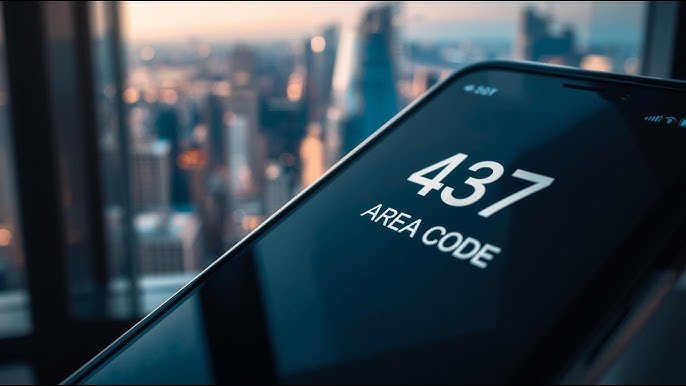
437 at a Glance
| Category | Details |
| Country/Province | Canada, Ontario |
| Coverage Area | City of Toronto, including Scarborough, Etobicoke, North York |
| Went Into Service | March 25, 2013 |
| Time Zone | Eastern Time (EST: UTC-5 / EDT: UTC-4) |
| Overlay Codes | 416, 647 |
| Dialing Format | +1-437-XXX-XXXX |
| Known For | Toronto’s financial district, tech sector, and film industry |
How Toronto Ended Up With Three Overlapping Codes
Toronto’s phone story starts with a single code, 416, assigned back when the North American Numbering Plan was first introduced in 1947. For decades, that was enough. But Toronto’s growth as Canada’s largest city and financial capital eventually caught up with its numbering supply. The first overlay, 647, arrived in 2001 to add breathing room. Even that additional pool wasn’t enough to keep pace with the smartphone era, so 437 launched on March 25, 2013, becoming the third code layered directly onto the exact same Toronto footprint.
Where 437 Numbers Actually Come From
437 sticks specifically to the City of Toronto’s official municipal boundaries, rather than sprawling across the wider Greater Toronto Area. That includes:
- Downtown Toronto and the financial district on Bay Street
- Scarborough
- Etobicoke
- North York
Notably, this code does not extend into nearby cities like Mississauga, Vaughan, or Hamilton, which fall under separate area codes entirely. If a number carries the 437 prefix, you’re looking at someone connected specifically to Toronto proper, not its outer suburbs.
Why the Surrounding Suburbs Use Completely Different Codes
Here’s a distinction worth understanding: the Greater Toronto Area, or GTA, which includes fast-growing suburban cities surrounding Toronto, runs on its own separate set of codes altogether, including 905, 289, 365, and 742. So while 437 confirms a connection to Toronto’s urban core, someone calling from Mississauga or Brampton just outside the city would carry one of those other prefixes instead, even though they’re part of the same broader metropolitan region day to day.
The City Behind This Code
Toronto’s roots go back further than most people expect. It began as a British settlement called York in 1793, before being renamed Toronto in 1834. Today, it’s grown into one of North America’s most diversified economies, home to Canada’s “Big Five” banks headquartered on Bay Street, a booming technology sector that’s earned Toronto the nickname “Silicon Valley North,” and a film production industry large enough to rank as the third-biggest in North America, frequently standing in for New York in Hollywood productions.
Converting Eastern Time for an Indian Schedule
437 runs on Eastern Time, sitting at UTC-5 through the winter months and shifting to UTC-4 once daylight saving begins each spring. Converted for Indian Standard Time, that generally means Toronto runs about 9.5 to 10.5 hours behind Delhi or Mumbai, with the exact gap depending on the season. A useful shortcut: if you’re wrapping up dinner around 8:30 PM in India, your Toronto contact is likely just settling into their workday, somewhere between 10 and 11 AM. Since daylight saving shifts happen twice yearly, in March and November, it’s worth rechecking the gap around those dates rather than assuming it stays constant.
Sharing the Same Territory as 416 and 647
Because 437 was introduced purely as an overlay, it occupies identical geography to both 416 and 647. All three codes can technically belong to numbers registered from the very same Toronto block or even the same office building. There’s no way to tell location more precisely just from which of the three codes someone carries — it depends entirely on which numbers happened to be available when they registered their line. As with most modern overlay systems, ten-digit dialing is mandatory even for local calls within the city, precisely to avoid confusion between the overlapping codes.
Dialling a 437 Number From India
From within North America, dialling is straightforward: 1-437-XXX-XXXX. From India, add your international access code first, then the country code for Canada, which happens to be the same as the US, giving you 00-1-437-XXX-XXXX, or simply the “+” symbol if your smartphone auto-formats international numbers. As always, number portability applies here too — someone holding a 437 number could have relocated away from Toronto entirely while keeping their original digits, so the code confirms where the number was first issued, not necessarily where that person lives today.
FAQs
Q1. Is calling a 437 number from India any different from calling a US number?
No, practically speaking. Canada shares the same country code, +1, with the US and the rest of North America, so the dialling process from India is identical regardless of whether the number is American or Canadian.
Q2. Does a 437 number mean the person is definitely in Toronto proper, not the suburbs?
It strongly suggests it, since 437 covers the City of Toronto’s official boundaries specifically. Someone in a nearby suburb like Mississauga or Brampton would typically carry a different code, such as 905 or 289, instead.
Q3. Why do three different area codes all serve the exact same city?
Toronto’s population and phone demand grew faster than any single code could sustain. Rather than dividing the city geographically, regulators layered 647 and later 437 directly on top of the original 416 territory, letting all three coexist across the same area.
Q4. Can an Indian business get a 437 number to establish a Toronto presence?
Yes, virtual number providers commonly offer 437 numbers to businesses anywhere in the world, letting Indian companies set up a Toronto-facing contact point for clients or customer support without needing a physical Canadian office.