When New York regulators announced Manhattan’s newest area code in 2015, local press didn’t exactly celebrate. Coverage at the time described the choice using words like “weird” and “lame,” a genuine media eye-roll aimed specifically at the fact that 332 didn’t share the visual rhythm of Manhattan’s older, more iconic codes, and that being yet another overlay meant it offered zero additional prestige to claim. That reaction says something real about how attached New Yorkers have become to their phone numbers as status symbols, even when the underlying function is identical.
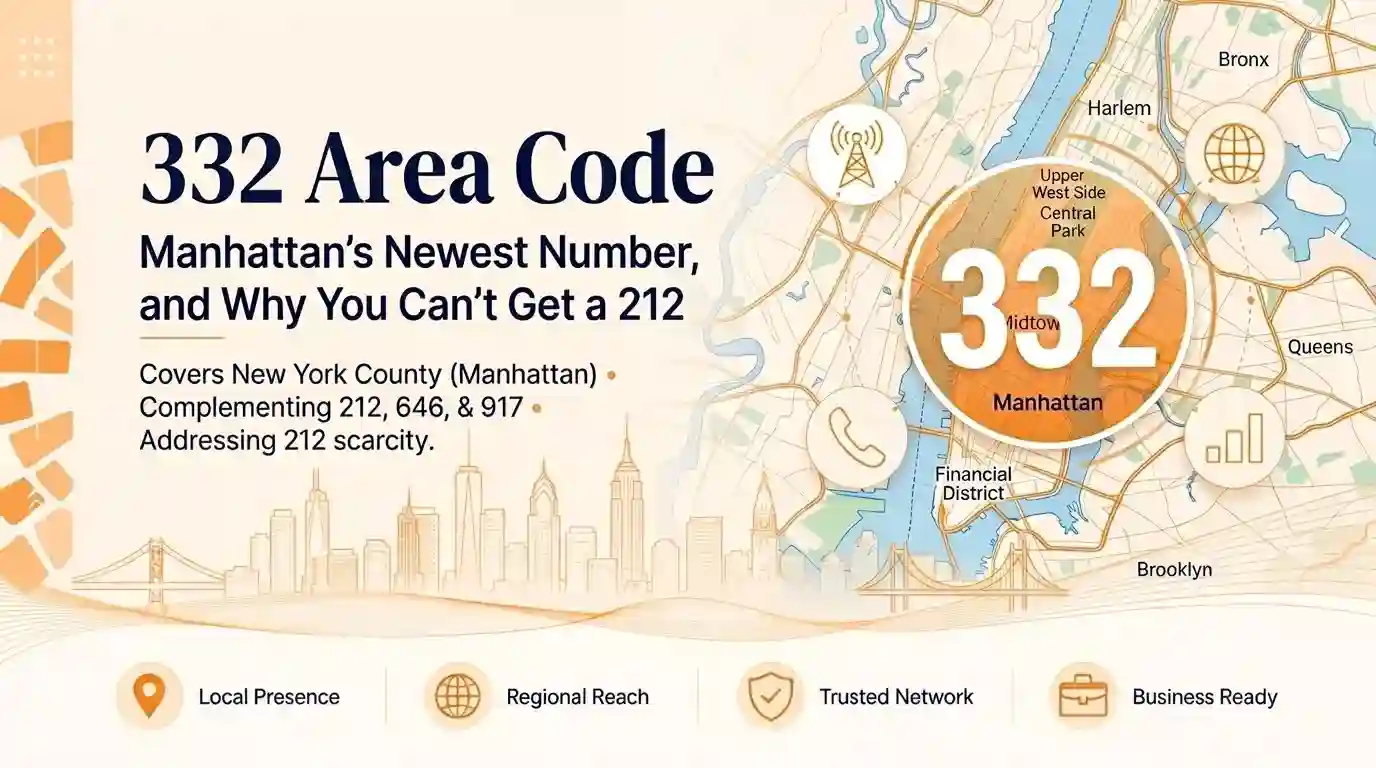
Manhattan’s Newest Overlay, At a Glance
| Category | Details |
| State | New York, USA |
| Coverage Area | Manhattan — Financial District to Inwood |
| Went Into Service | June 10, 2017 |
| Time Zone | Eastern Time (EST: UTC-5 / EDT: UTC-4) |
| Shares Territory With | 212, 646, 917 |
| Approved By Regulators | November 2015 |
The Fourth Code Manhattan Never Asked For
By the mid-2010s, projections from the North American Numbering Plan Administrator showed that 212, 646, and the Manhattan portion of 917 were all on track for genuine exhaustion. New York’s Public Service Commission approved 332 in 2015 specifically to head off that shortage, and it finally went live on June 10, 2017, becoming the seventh area code assigned to New York City’s broader overlay complex and the fourth serving Manhattan specifically.
Why the Digits Themselves Drew Criticism
Part of the backlash traced to something oddly aesthetic: New Yorkers had grown attached to the numeric patterns of 212, 646, and 917, each carrying a certain rhythm that felt distinctly “Manhattan” after decades of cultural reinforcement. 332 broke that pattern, and because overlay codes by definition don’t carve out new territory or offer any exclusivity, critics argued it added nothing except more numbers to dial, hence the “lame” label some outlets attached to it at launch.
A Genuine Quirk Hiding Inside Manhattan’s Own Borders
Here’s a detail that trips up even longtime Manhattan residents: Marble Hill, though officially part of the borough, doesn’t actually fall under this overlay complex at all. Due to a 19th-century canal that physically separated it from the rest of Manhattan Island, Marble Hill’s phone numbering followed the Bronx instead, meaning it sits under 718, 347, and 929 rather than 212, 646, 917, or 332.
Where This Code Actually Reaches
332 covers the entirety of Manhattan, running:
- The Financial District and Lower Manhattan
- Midtown, including the corporate core around Wall Street’s satellite offices
- The Upper East Side and Upper West Side
- Inwood and Washington Heights toward the island’s northern tip
Because this is a pure overlay rather than a geographic split, there’s no way to distinguish a caller’s specific neighbourhood from the code alone, all four Manhattan-area codes share exactly the same territory.
An Unusually Available Prestige Number
Here’s the practical upside buried inside that early criticism: because 332 launched more recently and inherited none of the scarcity that’s plagued 212 and 646 for years, it remains comparatively easy to obtain in 2026, while 646 in particular faces growing pressure as the decade progresses. For businesses wanting genuine Manhattan credibility without the premiums or waiting lists that older codes now command, 332 offers identical local recognition at considerably better availability.
Living Inside a Four-Code Overlay
Because 212, 646, 917, and 332 all cover identical Manhattan geography, two neighbouring offices in SoHo could easily carry different codes today, purely depending on when each business registered its line. Ten-digit dialing has applied throughout this overlay complex since 2017, and the pricing, coverage, and call quality remain completely unaffected by which of the four codes a given number carries.
Frequently Asked Questions
Q1. Is it true that New Yorkers actually complained about 332 when it launched?
Yes, this is documented. Local press coverage at the time used dismissive language, calling the new code “weird” and “lame,” largely because it lacked the numeric rhythm of Manhattan’s older codes and offered no exclusivity as a pure overlay.
Q2. Why doesn’t Marble Hill use 332 even though it’s officially part of Manhattan?
Marble Hill was physically separated from the rest of Manhattan Island by a canal dug in 1895, and its phone numbering historically followed the Bronx as a result, placing it under 718, 347, and 929 instead of the Manhattan overlay complex.
Q3. Is a 332 number less credible than a 212 or 646 number for a Manhattan business?
Functionally, no. All four codes carry equal local recognition and work identically for calls, texts, and business registration, though 212 in particular retains stronger legacy prestige simply for being the original code.
Q4. Can a business outside New York get a 332 number to establish a Manhattan presence?
Yes, virtual number and VoIP providers commonly issue 332 numbers to businesses anywhere, letting them establish an authentic Manhattan-facing identity for fintech, creative agencies, or general business outreach without needing a physical New York office or lease.