New Hampshire came genuinely close to losing its single-code status. Back in 2011, regulators projected 603 would exhaust its available numbers by 2013, and a second area code was actually expected to launch through a statewide overlay. It never happened. Changes in allocation policy, including number pooling and the reclamation of a large block of previously assigned numbers, pushed that exhaustion date out to at least 2032, sparing New Hampshire from joining the growing list of states running multiple area codes.
New Hampshire, By the Numbers
| Category | Details |
| State | New Hampshire, USA |
| Coverage Area | Manchester, Nashua, Concord, Portsmouth |
| Went Into Service | October 1947 |
| Time Zone | Eastern Time (EST: UTC-5 / EDT: UTC-4) |
| Overlay Status | None — sole code for the entire state |
| Projected Exhaustion | Not before 2032 |
Statewide Since Day One, Never Once Split
603 launched in October 1947 as one of the original 86 area codes, and its middle digit, a 0, confirmed from the start that regulators intended it to cover New Hampshire in its entirety. Nearly eight decades later, that assignment has never changed, making 603 one of just 11 American states still served by a single area code without any split or overlay layered onto it.
A Code Tied to America’s First Presidential Primary
New Hampshire’s cultural and political significance runs directly through this code, most notably through the state’s first-in-the-nation presidential primary, a tradition that draws national media attention and candidate visits every election cycle. That political prominence sits alongside 603’s role connecting the state’s genuinely varied economy, spanning technology and healthcare in the southern urban centres to tourism and outdoor recreation throughout the White Mountains and Lakes Region.
Where This Code Actually Reaches
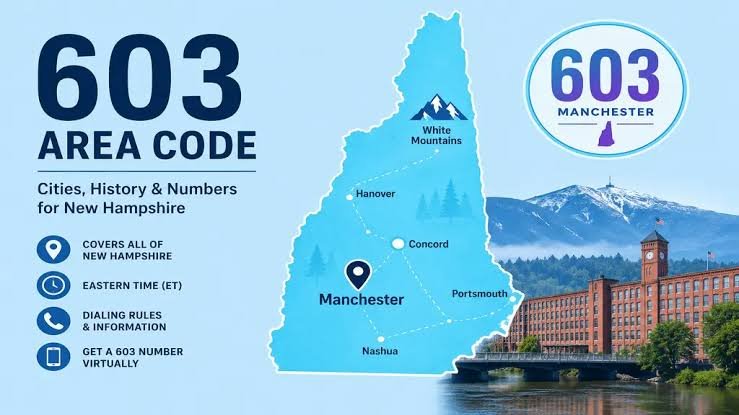
603 covers all 10 counties and 234 municipalities across New Hampshire without exception:
- Manchester and Nashua, the state’s largest urban centres
- Concord, the state capital
- Dover and Portsmouth along the seacoast
- The rural North Country and White Mountains region
Manchester’s Millyard Museum, preserving the city’s industrial history since 1975, sits within this territory, reflecting the manufacturing heritage that shaped the state’s largest city long before its modern technology and healthcare-driven economy took hold.
A Small, Compact State That Never Outgrew Its Code
New Hampshire’s relatively modest population, approximately 1.4 million residents, combined with the state’s compact geography, explains why 603 has never needed the numbering relief that’s forced splits and overlays onto larger, denser states. That stability has held even through the genuine 2011 exhaustion scare, when regulators temporarily believed a second code was inevitable within just a couple of years.
Ten-Digit Dialing Arrived Without Any Second Code
Unlike most American regions where ten-digit dialing signals an overlay has joined the territory, New Hampshire adopted mandatory ten-digit dialing in 2021 purely as preparation for potential future numbering changes under national guidelines, not because a second code had actually arrived. That distinction means every New Hampshire call requires the full area code today, even though 603 remains the state’s only prefix.
A Recognisable Code That Signals Genuine State Presence
Because 603 has represented the entirety of New Hampshire continuously since 1947, seeing it on caller ID signals unambiguous, genuine state presence to anyone receiving a call. That singular identity gives businesses carrying a 603 number real local credibility, since there’s no competing code splitting recognition across the state the way overlapping prefixes do elsewhere.
Frequently Asked Questions
Q1. Is it true that New Hampshire nearly got a second area code back in 2011?
Yes, this is documented regulatory history. Projections at the time suggested 603 would exhaust by 2013, and a statewide overlay was genuinely expected, but number pooling and reclaimed number blocks pushed that exhaustion date out to at least 2032.
Q2. Why has New Hampshire never needed a split or overlay like most other states?
The state’s comparatively small population and compact geography have kept demand for phone numbers well within what the original 1947 allocation can sustain, a stability that held even through the near-miss exhaustion scare of the early 2010s.
Q3. Does New Hampshire’s ten-digit dialing requirement mean a second area code has arrived?
No. Ten-digit dialing became mandatory in 2021 purely as preparation for potential future numbering changes, not because any overlay has actually joined 603. It remains the state’s sole area code.
Q4. Can a business outside New Hampshire get a 603 number to establish a statewide presence?
Yes, virtual number providers commonly issue 603 numbers to businesses anywhere, letting them establish a genuine New Hampshire-wide presence for tourism, healthcare, or general business outreach without needing a physical office in the state.