Rochester carries two nicknames that sound nearly identical but mean completely different things: the “Flower City,” honouring its floriculture industry, and the “Flour City,” a nod to the mills that once lined the Genesee River grinding wheat into flour. That dual industrial heritage sits inside the 585 area code, the numbering territory covering Rochester and New York’s Finger Lakes region.
Western New York, At a Glance
| Category | Details |
| State | New York, USA |
| Coverage Area | Rochester, Greece, Irondequoit, Canandaigua |
| Went Into Service | November 15, 2001 |
| Time Zone | Eastern Time (EST: UTC-5 / EDT: UTC-4) |
| Overlay Status | None — sole code for its territory |
| Split From | 716 |
A Split That Separated Two Distinct Western New York Cities
585 launched on November 15, 2001, breaking away from 716, which had covered all of western New York, including both Rochester and Buffalo, since 1947. That split gave Rochester and its surrounding nine counties their own dedicated numbering identity for the first time, distinct from Buffalo’s territory further west.
From Kodak Film to Photonics Research
Rochester’s economic identity has genuinely transformed since 585’s launch. Once home to Eastman Kodak, Xerox, and Bausch & Lomb, three companies that anchored the city’s manufacturing base for generations, Rochester has evolved into a centre for optics, imaging, and photonics research. That shift from traditional manufacturing to advanced technical research reflects a broader economic reinvention playing out across much of the American Rust Belt, though Rochester’s optics legacy gives it a genuinely distinct technical specialty.
Where This Code Actually Reaches
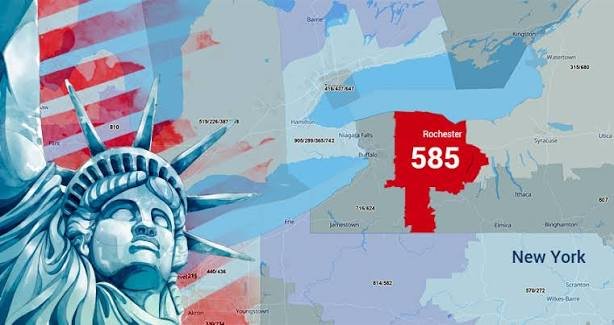
585 spans nine counties across western New York, wrapping around where the Genesee River empties into Lake Ontario:
- Rochester, downtown office towers and imaging research labs
- Greece, Irondequoit, and Brighton, dense suburban communities
- Batavia to the west and Canandaigua and Geneseo to the south
- The Finger Lakes wine country
Canandaigua and the surrounding Finger Lakes towns give this code a genuine wine country identity, meaning a call to a local winery or lake house in that region likely opens with the same 585 prefix as a Rochester tech company downtown.
A Population That’s Stayed Remarkably Steady
Unlike many American metro codes that eventually require overlays as their populations boom, Rochester’s population has held roughly flat over the past decade. That stability means 585 isn’t expected to face the kind of numbering exhaustion that’s forced overlay codes onto faster-growing regions, letting businesses that secure a 585 number today expect it to remain the area’s only prefix for the foreseeable future.
An Economy Anchored by Education and Healthcare
Beyond its optics and imaging legacy, this region’s largest employers today include the University of Rochester and Rochester Regional Health, reflecting how thoroughly education and healthcare have come to anchor the local economy. Financial services, manufacturing, and agriculture round out a genuinely diversified economic base spanning both Rochester’s urban core and the surrounding rural Genesee Valley.
Two Decades of Consistent Regional Identity
Because 585 has served as Rochester’s sole area code continuously since 2001, it’s built genuine consistency across two decades of business listings and marketing materials throughout the region. Local sports teams, businesses, and even musicians have embraced the code as a badge of regional pride, a familiarity that translates directly into better answer rates for businesses calling customers within the area.
Frequently Asked Questions
Q1. Why does Rochester have two seemingly contradictory nicknames, “Flower City” and “Flour City”?
Both reflect genuine historical industries: “Flour City” honours the mills that once lined the Genesee River grinding wheat, while “Flower City” recognises Rochester’s significant floriculture and nursery industry, two distinct economic legacies that happened to produce similarly sounding nicknames.
Q2. Does 585 still cover Buffalo, given its origin as a split from 716?
No. Buffalo remained under 716, and 585 has focused specifically on Rochester and the surrounding Finger Lakes region since the 2001 split created this dedicated territory.
Q3. Is 585 likely to need an overlay code anytime soon like many other American metro areas?
Unlikely based on current projections. Rochester’s population has remained roughly flat over the past decade, meaning 585’s numbering pool isn’t facing the kind of pressure that’s forced overlays onto faster-growing regions elsewhere.
Q4. Can a business outside New York get a 585 number to establish a Rochester presence?
Yes, virtual number providers commonly issue 585 numbers to businesses anywhere, letting them establish a Rochester or Finger Lakes presence for technology, healthcare, or general business outreach without needing a physical New York office.