Outside the Amazon Rainforest, no region on Earth hosts more bird species than the desert stretching across southern Arizona. That astonishing biodiversity sits inside the 520 area code, the numbering territory anchoring Tucson, a city whose own history reaches back roughly 4,000 years, long before anyone dreamed of telephones, let alone area codes.
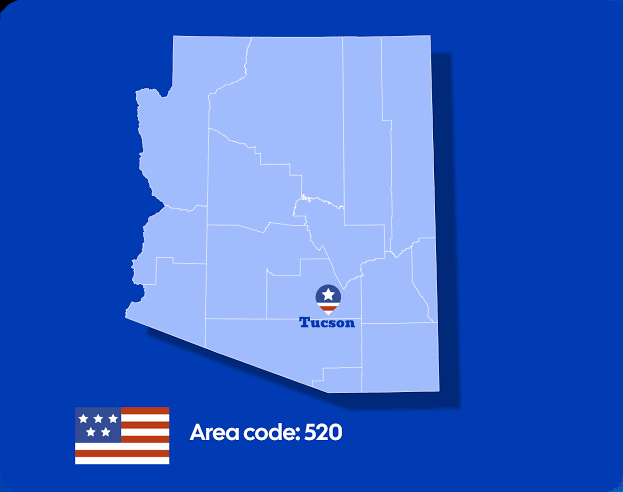
Southeastern Arizona, At a Glance
| Category | Details |
| State | Arizona, USA |
| Coverage Area | Tucson, Nogales, Sierra Vista, Casa Grande |
| Went Into Service | March 19, 1995 |
| Time Zone | Mountain Standard Time, year-round (no DST observed) |
| Overlay Code | 945 |
| Split From | 602 |
Arizona’s Second Area Code, Then a Further Split
Before 1995, all of Arizona ran on a single code, 602, dating back to the original 1947 numbering plan. As the state’s population exploded, 520 split away on March 19, 1995, covering a huge swath of the state. That territory proved too large to last, and on June 23, 2001, the northern and western portions split away entirely into 928, narrowing 520 down to focus specifically on southeastern Arizona and the border region.
An Ancient City That Predates Statehood by Millennia
Tucson holds genuine claim as Arizona’s oldest city, with archaeological evidence showing farming communities settled at the base of Sentinel Peak roughly 4,000 years before the city’s formal 1877 incorporation. That peak, now known locally as “A” Mountain because of its connection to the University of Arizona, once served the Spanish as a strategic lookout point when the region belonged to New Spain.
A Border Economy Found Nowhere Else in Arizona
Unlike Phoenix-area codes to the north, this territory covers the entire US-Mexico border corridor running from Nogales to Douglas, a genuine cross-border economic zone built around international trade and binational commerce. Sierra Vista adds a distinct military dimension to that mix, sitting near Fort Huachuca, a major US Army installation that anchors substantial regional employment.
Where This Code Actually Reaches
520 spans Pima, Cochise, Santa Cruz, and portions of Pinal County across southeastern Arizona:
- Tucson, the region’s largest city and home to the University of Arizona
- Nogales and Rio Rico, key border crossing communities
- Sierra Vista, Douglas, and Bisbee in Cochise County
- Casa Grande, sitting along the corridor between Tucson and Phoenix
Tucson alone receives roughly 350 days of sunshine annually, more than almost any other American city, a climate that’s helped build the region’s reputation for astronomy research alongside its desert tourism industry.
A Clock That Never Springs Forward or Falls Back
Arizona famously doesn’t observe Daylight Saving Time, meaning this region stays fixed on Mountain Standard Time throughout the entire year. For roughly half the year that aligns Tucson with the Mountain time zone generally, but during summer months, when most of the country shifts forward, this territory effectively matches Pacific Time instead, a quirk worth remembering when scheduling calls across state lines.
Why 945 Joined as an Overlay
Continued growth across southeastern Arizona eventually pushed 520’s numbering pool toward exhaustion, and regulators introduced 945 as an overlay rather than splitting the territory further. Both codes now share identical territory, letting new registrations draw from the added capacity while existing 520 numbers remain unchanged.
Frequently Asked Questions
Q1. Is it really true that this region hosts more bird species than anywhere except the Amazon?
Yes, this is a documented distinction among birding communities and researchers. The desert ecosystems surrounding Tucson support an exceptional concentration of bird species, a biodiversity claim exceeded only by the Amazon Rainforest.
Q2. Does 520 still cover Flagstaff or Prescott, given its original 1995 territory?
No. Those northern and western Arizona regions split away into 928 in 2001, and 520 has focused specifically on southeastern Arizona and the border corridor ever since.
Q3. Why does southern Arizona sometimes align with Pacific Time instead of Mountain Time?
Because Arizona doesn’t observe Daylight Saving Time, its clock stays fixed year-round. During the months when most of the country shifts to daylight time, that fixed position effectively puts southern Arizona on the same clock as Pacific Time states.
Q4. Can a business outside Arizona get a 520 number to establish a Tucson presence?
Yes, virtual number providers commonly issue 520 or 945 numbers to businesses anywhere, letting them establish a Tucson or border-region presence for trade, defence contracting, or general business outreach without needing a physical Arizona office.