If you strip away every other California area code and ask which one carries the most history, 213 wins hands down. It was there before 323, before 738, before mobile phones even existed as a concept. So when a number starting with 213 shows up on your screen, you’re looking at a direct line to the original heart of Los Angeles — not a suburb, not an overlay afterthought, but the actual starting point of the city’s phone system. Whether you’re chasing a US client, verifying an unknown caller, or setting up a number that sounds authentically LA, here’s the full picture.
213 at a Glance
| Category | Details |
| State | California, USA |
| Coverage Area | Downtown Los Angeles, Koreatown, Chinatown, Echo Park, Westlake |
| Went Into Service | 1947 |
| Time Zone | Pacific Time (PST: UTC-8 / PDT: UTC-7) |
| Overlay Codes | 323, 738 |
| Dialing Format | +1-213-XXX-XXXX |
| Known For | Being one of the original US area codes, downtown business and entertainment hub |
Why 213 Is Different From Every Other LA Code
Most area codes get introduced quietly to relieve pressure on an older one. 213 didn’t have that luxury — it was there from day one, in 1947, back when the entire concept of a “California area code” was brand new. At the time, it didn’t just cover Downtown LA; it stretched across a much larger chunk of Southern California before decades of population growth forced multiple splits. Every other code you’ll come across in the region, from 323 to 424 to 738, traces its existence back to 213 running out of room. That makes 213 less of a random prefix and more of a piece of the city’s actual telecom origin story.
Where 213 Numbers Actually Come From Today
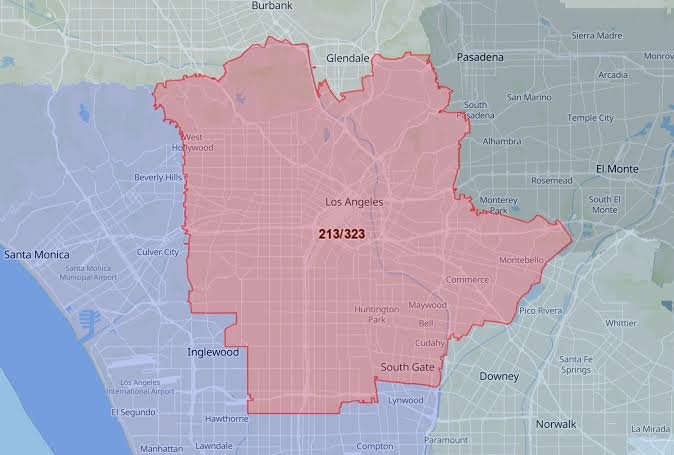
After all the splits, what remains under 213 is a tight, dense cluster right in the city’s historic core:
- Downtown Los Angeles, including the Financial District
- Koreatown
- Chinatown
- Westlake
- Echo Park’s western edge
This isn’t a code that reaches into the suburbs or stretches across county lines. It stays concentrated in the neighbourhoods that built LA’s original commercial identity, which is exactly why businesses that want to project an “established downtown LA” image often go out of their way to secure a 213 number specifically.
The Overlay Setup: Sharing Space With 323 and 738
Once 213 started running low on available combinations back in the 1990s, regulators didn’t redraw the map. Instead, they introduced 323 as an overlay in 1998, letting it occupy the exact same geographic footprint. Decades later, as both codes filled up further, 738 joined the same overlay complex in November 2024. The result is that three completely different area codes — 213, 323, and 738 — can all belong to numbers registered from the identical block of Downtown LA. There’s no way to tell just from location which of the three someone will end up with; it depends entirely on which numbers happen to be available when they sign up.
Why Entertainment and Media Businesses Favour This Code
Downtown LA has increasingly become a hub for production companies, media startups, and creative agencies moving away from the traditional Hollywood strip. Because 213 is the oldest, most recognisable code tied to that exact geography, businesses chasing an “authentic LA” identity frequently request it over its newer overlay siblings. It’s partly nostalgia and partly branding — a 213 number quietly signals longevity in a city where everyone else is trying to look established.
Matching Pacific Time With Indian Schedules
213 sits in the Pacific Time zone, running at UTC-8 for most of the year and UTC-7 once daylight saving begins each spring. For someone working out of India, that generally translates to a gap of about 12.5 to 13.5 hours behind IST, with the precise figure shifting depending on the season. A simple way to keep it straight: if you’re logging off work around 9 PM in Delhi, your Downtown LA contact is likely just starting their morning, somewhere between 7:30 and 8:30 AM. Since daylight saving shifts happen twice a year, in March and November, it’s worth reconfirming the gap around those dates rather than assuming it stays constant.
Making the Call From India
Dialling a 213 number from within the US only requires 1-213-XXX-XXXX. From India, you’ll need your international access code first, followed by the US country code, giving you 00-1-213-XXX-XXXX, or simply the “+” symbol if you’re dialling from a smartphone that formats international numbers automatically. One thing worth remembering: number portability means someone holding a 213 number isn’t necessarily still sitting in Downtown LA. They could have relocated entirely while keeping the same digits, so the code only confirms where the number was first issued, not where the person is today.
FAQs
Q1. Is a 213 number worth more or considered more trustworthy than 323 or 738?
Not in any functional sense — all three are fully legitimate, equally active codes. The perceived value is purely reputational, tied to 213 being the oldest and most historically recognised of the three, which is why some businesses actively request it for branding reasons.
Q2. Can someone outside the US get a 213 number for their business?
Yes. Virtual number providers routinely offer 213 numbers to businesses based anywhere, including India, letting them establish a Downtown LA presence for customer calls or marketing without needing a physical office there.
Q3. Why do calls from the same LA neighbourhood sometimes show different area codes?
Because 213, 323, and 738 all share identical geography through the overlay system. Once one code’s numbering pool fills up, a new one gets layered on top rather than dividing the region, so neighbouring numbers can carry entirely different prefixes.
Q4. Does a 213 area code guarantee the caller is currently in Los Angeles?
No. The code reflects where the number was originally registered, not where the person lives now. Thanks to number portability, someone could carry their 213 number across cities or even countries after relocating.