Here’s something that trips up almost everyone dealing with Idaho: this single area code actually spans two different time zones. Most of the state runs on Mountain Time, but the northern panhandle, including Coeur d’Alene, sits on Pacific Time instead, a full hour behind the rest of the state. Two people holding 208 numbers could genuinely be an hour apart on the clock despite sharing the exact same area code.
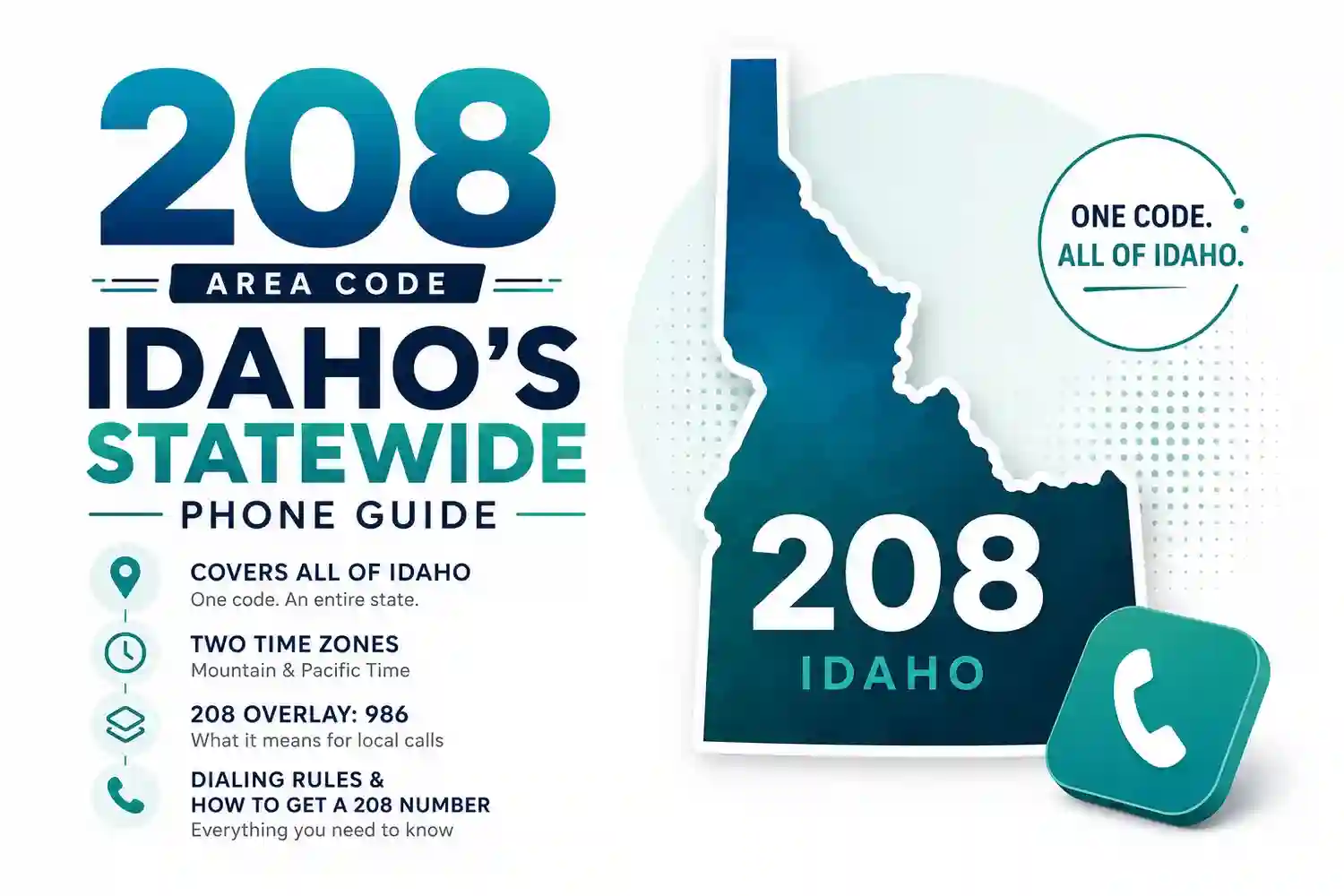
Idaho’s Statewide Code, At a Glance
| Category | Details |
| State | Idaho, USA |
| Coverage Area | Entire state — Boise, Idaho Falls, Coeur d’Alene, Twin Falls |
| Went Into Service | 1947 |
| Time Zone | Mountain Time (most of state) / Pacific Time (northern panhandle) |
| Overlay Code | 986 |
| Population Served | Over 2 million |
A Code That’s Covered the Whole State Since Day One
208 launched in 1947 as one of America’s original 86 area codes, and remarkably, it’s never needed a geographic split in nearly 80 years since. That’s genuinely rare among original 1947 codes, most states with comparable land area eventually divided their numbering system as population grew, but Idaho’s relatively modest population density meant a single code sufficed for decades longer than almost anywhere else in the country.
Why Two Time Zones Share One Area Code
Idaho’s geography creates this unusual split because the state’s panhandle sits closer to Spokane, Washington than to Boise, both economically and practically, and historically adopted Pacific Time to align with that regional connection. Meanwhile, the rest of the state, including Boise, Idaho Falls, and Twin Falls, runs on Mountain Time. Because area codes follow state numbering boundaries rather than time zone lines, 208 ended up straddling both without ever needing to split for that reason.
Idaho’s Population Finally Crossed Two Million
For the first time in the state’s history, Idaho’s population crossed two million residents in 2024, a milestone reached largely through people relocating from California, Washington, and Oregon rather than natural growth alone. Much of that influx has concentrated specifically in the Boise metropolitan corridor, which grew by nearly 25 percent between 2014 and 2024, adding over 150,000 new residents and reshaping what was previously a considerably quieter regional capital.
From Mountain Towns to Tech Corridors
208 covers genuinely varied terrain across Idaho:
- Boise, Meridian, and Nampa, the fast-growing Treasure Valley corridor
- Idaho Falls and Pocatello in the state’s east
- Coeur d’Alene and Sandpoint in the northern panhandle
- Twin Falls and Burley, anchoring the state’s agricultural south
Boise itself has increasingly attracted technology and healthcare businesses alongside its traditional government and education base, a shift driven substantially by the same out-of-state migration reshaping the broader Treasure Valley.
How Idaho Delayed Needing a Second Code for So Long
Even as demand grew through the early 2000s, Idaho managed to postpone introducing a second code by relying on number pooling techniques, essentially redistributing unused number blocks more efficiently rather than assigning fresh combinations outright. That approach bought the state considerable extra time, and it wasn’t until 2017 that 986 finally launched as an overlay, specifically to serve the booming Boise metro area without disrupting anyone’s existing 208 number.
A Number That Idaho Residents Genuinely Identify With
Because 208 represented literally the entire state for seven decades before any overlay arrived, it’s become something close to a statewide identity marker rather than just a regional prefix. Businesses across Idaho, whether based in Boise’s tech corridor or a small agricultural town near Twin Falls, still overwhelmingly favour 208 specifically, leaning on decades of unbroken association between those three digits and belonging to Idaho itself.
Frequently Asked Questions
Q1. How is it possible for one area code to span two different time zones?
Idaho’s panhandle region historically aligned with Pacific Time due to its closer economic ties to Spokane, Washington, while the rest of the state runs on Mountain Time. Since area codes follow state boundaries rather than time zone lines, 208 ended up covering both zones without ever needing a split specifically for that reason.
Q2. Does a 208 number always mean the caller is in Boise specifically?
No. Since 208 covers the entire state of Idaho, a call could just as easily come from Coeur d’Alene in the north, Twin Falls in the south, or Idaho Falls in the east, all considerably distant from Boise itself.
Q3. Why did Idaho manage to avoid splitting its area code for so much longer than most other states?
Idaho’s comparatively low population density meant demand for phone numbers grew more slowly than in denser states, and later, number pooling techniques further extended the available supply, delaying the need for any relief until the 986 overlay finally launched in 2017.
Q4. Can a business outside Idaho get a 208 number to establish a statewide Idaho presence?
Yes, virtual number providers commonly issue 208 or 986 numbers to businesses anywhere, letting them project genuine Idaho identity for technology, healthcare, agriculture, or general business outreach without needing a physical office in the state.