Central Phoenix packs an unusual amount of landmark density into roughly 230 square miles: the Arizona State Capitol, Sky Harbor International Airport, Chase Field, and a downtown Arizona State University campus all sit within the same compact stretch. That’s the territory this code covers today, a sharp contraction from what 602 used to represent back when it was Arizona’s only area code, covering literally the entire state.
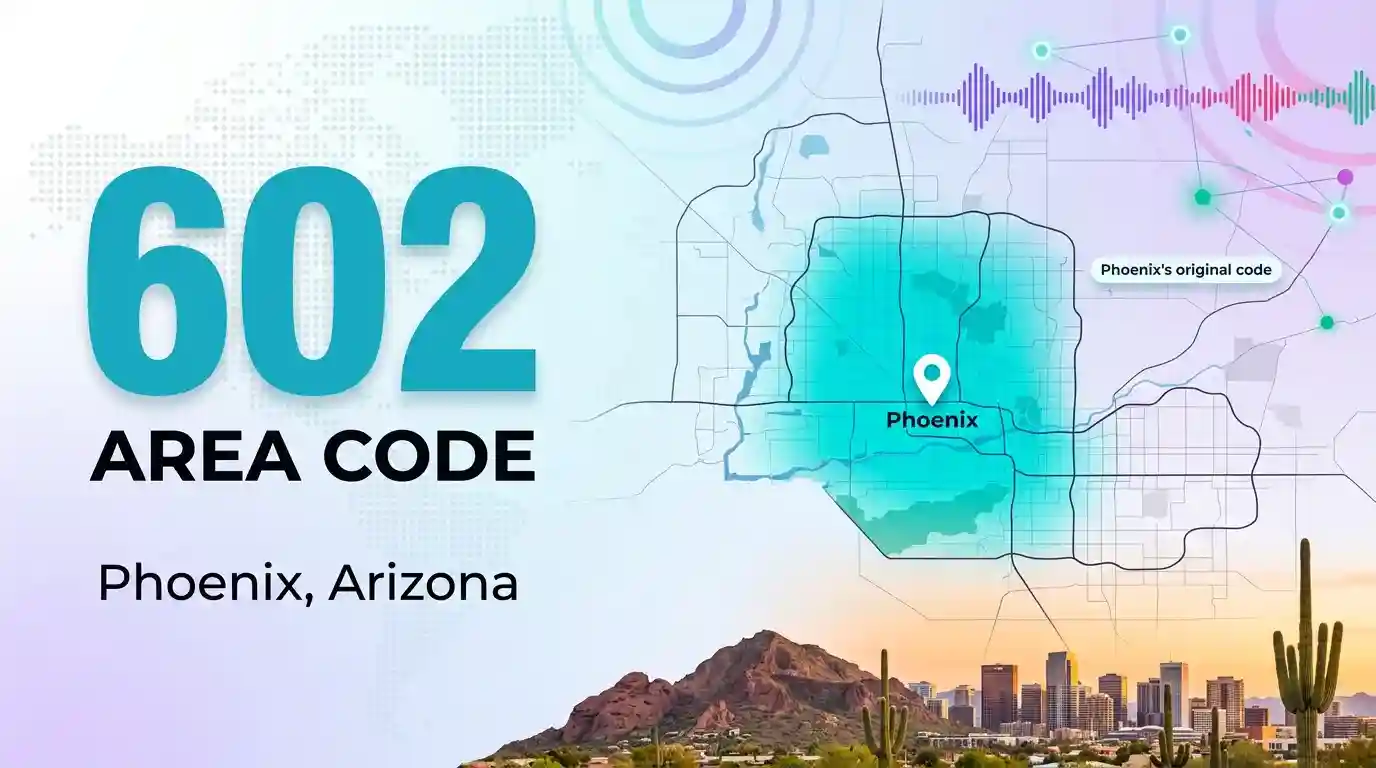
Central Phoenix at a Glance
| Category | Details |
| State | Arizona, USA |
| Coverage Area | Central Phoenix — downtown, Camelback East, Arcadia |
| Went Into Service | 1947 |
| Time Zone | Mountain Standard Time (UTC-7, no DST observed) |
| Shares Territory With | 480, 623 |
| County | Maricopa |
From an Entire State to Just the Downtown Core
602 launched in 1947 as one of America’s original 86 area codes, covering all of Arizona without exception. That single-code arrangement held for nearly five decades before growth finally forced a reckoning. 520 split away in 1995 to take the state’s southern reaches, including Tucson. Then, in 1999, two more splits arrived almost simultaneously: 623 took over Phoenix’s western suburbs, and 480 claimed the eastern side. What survived in the middle, geographically small but historically the original, was central Phoenix itself.
Farmland That Became a Capital City
Before Phoenix grew into Arizona’s dominant metropolis, the land under this code supported cattle ranching, cotton fields, and citrus groves, a genuinely agricultural economy rather than the government and tourism hub it’s become. That shift accelerated as the city absorbed more residents and businesses, eventually attracting major corporate names including American Express, U-Haul, Freeport-McMoRan, and Honeywell’s Aerospace division, alongside its role as Arizona’s seat of government and home to Arizona State University’s downtown presence.
A Split, Not an Overlay, Between Phoenix’s Three Codes
Here’s a distinction worth understanding clearly: unlike many American metros where multiple codes overlay identical territory, Phoenix historically divided its numbering geographically. 602 covers central Phoenix specifically, 480 covers the East Valley suburbs like Scottsdale and Tempe, and 623 covers the West Valley including Glendale and Peoria. Each code traditionally mapped to a genuinely different part of the metro rather than sharing the same ground.
Why That Distinction Blurred in 2023
That clean geographic separation changed somewhat in 2023, when the Arizona Corporation Commission implemented what’s called a boundary elimination overlay across all three codes, removing the strict dividing lines between them and requiring mandatory ten-digit dialing throughout the entire Phoenix metro. New numbers today can technically be assigned from any of the three codes regardless of which specific part of the Valley a customer sits in, even though the historical association between each code and its original territory still holds for most existing numbers.
A Clock That Shifts Its Alignment Twice a Year
Arizona’s decision not to observe Daylight Saving Time creates a genuinely unusual seasonal effect worth knowing if you deal with this region often: during summer months, Phoenix’s fixed clock effectively lines up with Pacific Time cities like Los Angeles, while in winter it shifts to matching Mountain Time cities like Denver instead. The state itself never moves its clocks, but its relationship to the rest of the country’s time zones quietly shifts underneath it every spring and fall.
Why Original-Code Status Still Carries Weight
Because 602 is literally Arizona’s founding area code, businesses in central Phoenix specifically pursuing it over 480 or 623 are leaning on genuine historical depth, a signal that a company is rooted in the city’s original core rather than its more recently developed suburban rings. Given how fast Phoenix continues expanding, particularly in real estate, healthcare, and semiconductor manufacturing, that distinction still carries real marketing value for businesses trying to differentiate a downtown presence from a suburban one.
Frequently Asked Questions
Q1. Does 602 still function as a purely geographic code, or does it now overlap with 480 and 623 everywhere?
Since the 2023 boundary elimination, the three codes technically share the same numbering pool across the Phoenix metro, though most existing 602 numbers still trace back to central Phoenix specifically, reflecting the code’s original geographic assignment before the boundaries were formally erased.
Q2. Why does Phoenix’s time zone relationship to the rest of the US change between summer and winter?
Because Arizona doesn’t observe Daylight Saving Time, its clock stays fixed year-round while most other US regions shift theirs. That fixed position means Phoenix effectively aligns with Pacific Time in summer and Mountain Time in winter, even though Arizona’s own clock never actually moves.
Q3. Is a 602 number more valuable for a Phoenix business than one from 480 or 623?
There’s a genuine perception advantage tied to 602 being Arizona’s original 1947 code, often read locally as signaling deeper roots in central Phoenix specifically, though all three codes function identically for calls, texts, and business registration.
Q4. Can a company outside Arizona get a 602 number to establish a downtown Phoenix presence?
Yes, virtual number providers commonly issue 602 numbers to businesses anywhere, letting them project a central Phoenix identity for real estate, tourism, or corporate outreach without needing a physical downtown office.