Here’s a quirk that trips up almost everyone scheduling a call to this part of the US: Arizona doesn’t observe Daylight Saving Time. While most of the country shifts clocks forward every spring, this state simply doesn’t bother, which means the gap between here and anywhere else in the world actually changes twice a year, even though Arizona’s own clock never moves. Get that wrong and you’ll show up an hour off for half the year without realising why.
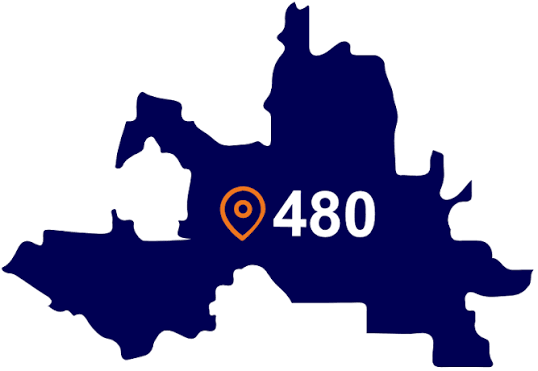
Snapshot: 480 in Arizona’s East Valley
| Category | Details |
| State | Arizona, USA |
| Coverage Area | Scottsdale, Tempe, Mesa, Chandler, Gilbert |
| Went Into Service | 1999 |
| Time Zone | Mountain Standard Time (UTC-7, no DST observed) |
| Shares Territory With | 602, 623 |
| Population Served | Roughly 1.5 million |
Why This Region Split Off From Phoenix’s Original Code
Before 1999, this entire stretch of Arizona ran on 602, the state’s original area code. Nobody quite anticipated how fast the Phoenix metro would grow through the 1990s, and by the time regulators caught up, the numbering pool couldn’t keep pace with the sheer volume of new residents and businesses. Rather than one straightforward split, Arizona’s Corporation Commission divided the territory three ways at once, creating both 480 and 623 simultaneously alongside the original 602. 480 took the eastern and southeastern suburbs, an area locals now call the East Valley.
The Businesses That Made This Code Their Home
Scottsdale alone has attracted an unusual concentration of major corporate names, including AXA, GE Capital, DHL, Fidelity Investments, and GoDaddy, which built its identity here before growing into a globally recognised brand. Tempe carries its own list, home to Fortune 500 companies and, more memorably for casual visitors, the original headquarters of Cold Stone Creamery. Chandler has developed a reputation as something of a “Silicon Desert,” anchored by Intel and Microchip Technology, giving this single area code a genuinely diverse economic identity spanning finance, tourism, and semiconductors.
An Architectural Landmark Hiding in Plain Sight
Long before any of these companies arrived, Frank Lloyd Wright built his winter studio, Taliesin West, just outside Phoenix in 1939, choosing this desert landscape specifically for its light and terrain. That structure still stands today within this code’s territory, a reminder that the East Valley’s identity was drawing serious attention decades before tech companies and golf resorts turned it into the business hub it is now.
The Cities Carrying This Code
480 stretches across a genuinely broad section of Maricopa and Pinal counties:
- Scottsdale, known for luxury resorts and golf
- Tempe, home to Arizona State University’s largest campus
- Mesa, Arizona’s third-largest city
- Chandler and Gilbert, both fast-growing tech and residential hubs
Arizona State University in particular feeds a steady stream of graduates directly into the tech and business ecosystem that dominates this region, tightening the connection between the university town and the corporate headquarters surrounding it.
Living Alongside 602 and 623
Because Phoenix’s numbering system was split three ways rather than cleanly divided, 480, 602, and 623 all require full ten-digit dialing for every call, even between neighbours in the same East Valley suburb. A business in Scottsdale and one in Mesa might both carry 480 numbers, while a company just across the border in Phoenix proper likely holds a 602 number instead, reflecting how these three codes divide the metro rather than overlapping it entirely.
Why Remote Businesses Increasingly Want This Code
Since virtual numbers became widely accessible, companies well outside Arizona have started acquiring 480 numbers specifically to establish credibility in the East Valley market without relocating. Real estate agents, startups, and digital professionals use this approach to project local presence for search visibility and to improve answer rates with Scottsdale or Chandler-based customers who might otherwise screen out unfamiliar numbers.
Frequently Asked Questions
Q1. Why does Arizona’s lack of Daylight Saving Time actually matter for scheduling calls?
Because most of the world shifts clocks twice a year and Arizona doesn’t, the actual time difference between this region and anywhere else changes depending on the season, even though Arizona’s own clock stays fixed. Checking the current gap rather than assuming a fixed offset avoids scheduling errors.
Q2. Does the Navajo Nation follow the same no-DST rule as the rest of Arizona?
No, and this is a genuine exception worth knowing. The Navajo Nation, which extends into northeastern Arizona, does observe Daylight Saving Time, making it different from the rest of the state even though it’s geographically within Arizona’s borders.
Q3. Is a 480 number more valuable for business than one from 602 or 623?
Not inherently, since all three codes function identically for calls and business registration. The perceived advantage comes from 480 specifically covering Scottsdale, Chandler, and Tempe, regions with strong tech and tourism economies that businesses often want to signal association with.
Q4. Can someone outside the US get a 480 number to target this market?
Yes, virtual number and VoIP providers can issue 480 numbers to businesses anywhere in the world, letting them establish an East Valley presence for real estate, tech, or general business outreach without needing a physical Arizona address.